Measurement
The Feed Said 65 Posts. One Timestamp Said It Was a Build Step.
We score companies on whether they publish, and we read that from their RSS feed. For one company the feed said 65 posts in 90 days. Every item in it was stamped to the same second.
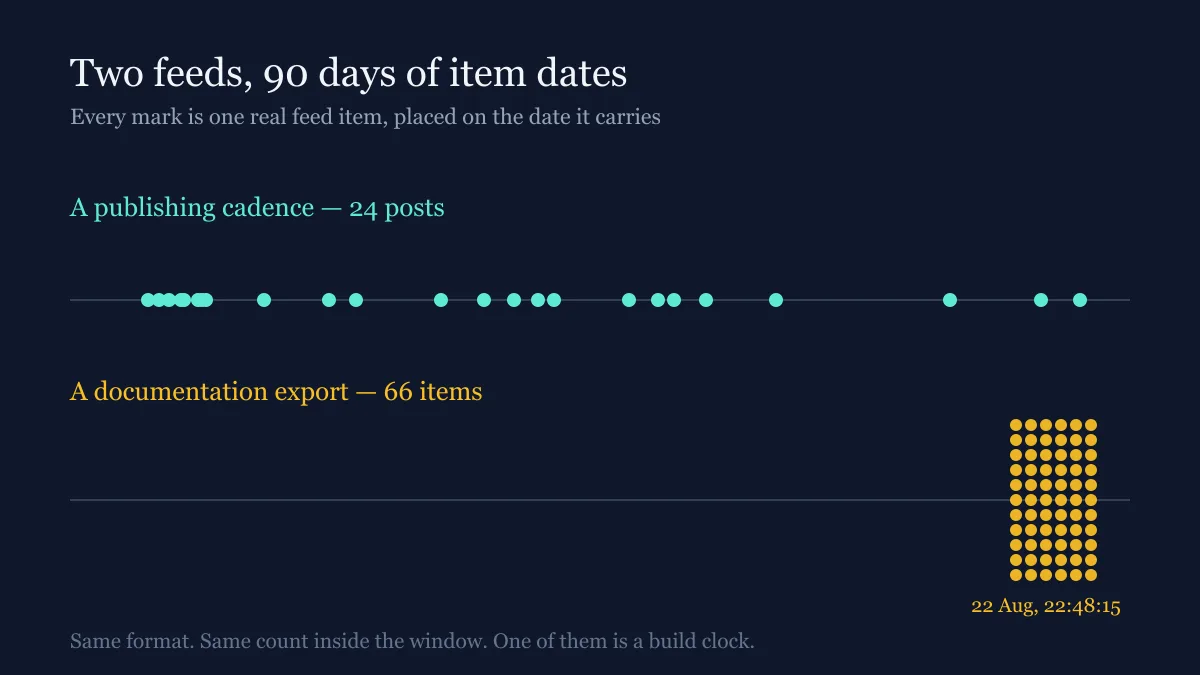
A company entered our pipeline at 65 posts in 90 days — an unusually strong reading of the one signal we qualify on. It was a documentation export. All 66 items in the feed carried the timestamp Sat, 22 Aug 2026 22:48:15 GMT, to the second. The company's actual blog had 24 posts. Our "publishes regularly" measure had read a build step.
What we thought we were measuring
We look for companies that publish consistently and are nonetheless absent when an AI assistant is asked their category's buying question. The publishing half is deliberately mechanical: find a feed on the company's own domain, count items dated inside the window. It is a decent proxy. A team that ships posts every week is a team with someone whose job includes writing.
The feed said 65. That is not merely passing; it is near the top of the range we see. We wrote to them.
How it came apart
They replied — the founder, saying he was aware of the gap and asking how to close it. Writing that answer meant reading their site properly rather than reading their feed, and the shape of the thing changed immediately. The 66 items were Quickstart, Core concepts, Data model, Rate limits, CLI overview. Reference pages. Their site generator emits one feed for every routed page it knows about, documentation included, and dates each item from the build.
So the number was real and the reading was wrong. Sixty-five things did enter that feed in the window. They entered it because the site was rebuilt, not because anyone wrote them that week.
The test
A generated export has a signature that a publishing history does not: timestamp concentration. Real posts were written on different days and their dates spread out. A build writes one clock value to everything it touches.
If at least five items carry dates and 80% or more of them share a single timestamp, the feed cannot tell you anything about cadence.
The important detail is what happens on a positive result. The check now returns unknown, not inactive. A generated feed is the absence of evidence about publishing, not evidence of absence — and this company does publish, 24 posts, the most recent six days before we looked. Scoring them quiet would have been a second error in the other direction, quietly deleting real prospects.
How far it had spread
The instinct after finding a measurement error is to assume it is everywhere. We ran the test across every company qualified from the same sweep.
| group | checked | exports found |
|---|---|---|
| sent prospects from this sweep with a feed on record | 5 | 1 |
| unsent prospects with a verified mailbox | 51 | 0 |
| feeds carrying no dates at all (set aside, unreadable) | 1 | — |
| total checked | 56 | 1 |
One in 56. The signal was sound in 55 cases, and we would not have known that without running the number — which is the point of running it rather than reasoning about how bad it probably was.
The falsifier
Eighty percent is a judgement call and can be wrong in both directions. Too permissive and clustered exports slip through; too strict and a real publisher who backfilled dates gets thrown away. So the threshold is on trial: hand-check every candidate the guard marks unknown across the next 100 qualified, and record which way each one was wrong. If more than one in ten of those rejections is a genuine publisher, the threshold moves. If an export gets through at 50–79% concentration, it moves the other way.
The general shape
A feed is an artifact of your target's build tooling. It is not a record they keep for your benefit, and nothing in the format separates written today from compiled today. Sitemaps, changelogs and commit histories are all like this: generated by machinery with its own reasons for writing a date, none of it designed to answer the question being asked of it.
Before treating any of them as a measure of human activity, go and find the case where the machine writes the value instead of the person — then test for that case directly, rather than trusting that it is rare.
Method: feeds fetched 2026-08-28. Concentration is the share of dated items carrying the single most common timestamp, computed over pubDate, updated and published elements. Companies are identified here only in aggregate; the case described replied to our outreach and the exchange is not reproduced. The guard now runs inside our qualification script, and returns UNKNOWN rather than a cadence figure.
Frequently asked
How can you tell an RSS feed is a generated export rather than a publishing cadence?
Look at how concentrated the timestamps are. A real publishing history spreads dates across the window, because the posts were written on different days. A generated export — a docs site, a migration, a static-site rebuild — writes one build time to every item, so the feed carries dozens of entries stamped to the same second. Our rule: if 80% or more of the dated items share a single timestamp and there are at least five of them, the feed cannot tell you anything about cadence.
Why does a documentation feed look identical to an active blog?
Because both are produced by the same machinery. Most static site generators emit one feed covering every routed page they know about, and set each item's date from file modification time or from the build clock. If a team runs their documentation through that pipeline, every docs page becomes a feed item dated at the moment the site was last built. Nothing in the feed format distinguishes 'written today' from 'compiled today'. The company in our case had 66 items dated to the same second, all of them reference pages: Quickstart, Data model, CLI overview, Rate limits.
What should the check report when a feed looks like an export?
Unknown, not inactive. A generated feed is the absence of evidence about cadence, not evidence that the company has stopped publishing. The company in our case does publish — 24 real posts on a separate blog, the most recent six days before we looked. Marking such a company 'quiet' would be a second error in the opposite direction, and it would silently remove real prospects from the pipeline.
How widespread was the problem once you tested for it?
Much smaller than the mistake felt. We ran the timestamp-concentration test across all 56 companies qualified from the same sweep: 55 had genuine date spread, one was the export we had already found, and one feed carried no dates at all and was set aside as unreadable. So the qualification signal was sound in 55 of 56 cases. We report the number because the instinct after finding a measurement error is to assume it is everywhere, and that instinct is worth checking rather than trusting.
What is the falsifier on the 80% threshold?
The threshold is a judgement call and could be wrong in either direction. Too permissive, and clustered-but-not-identical exports slip through; too strict, and a genuine publisher who backfilled dates gets rejected. So: hand-check every candidate the guard marks unknown across the next 100 qualified, and record which way each one was wrong. If more than one in ten of the rejections turns out to be a real publisher, the threshold is too aggressive and should move. If any export gets through with concentration between 50% and 79%, it is too permissive.
What is the general lesson for anyone scoring companies on public signals?
A feed is an artifact your target's build tooling produces, not a record they keep for you. The same holds for sitemaps, changelogs and commit histories: each is generated by machinery with its own reasons for writing a date, and none was designed to answer the question you are asking. Before treating any of them as a measure of human activity, find the failure mode where the machine writes the value instead of the person, and test for it directly.
More from the Journal
- Thirty Days of Publishing: 0 of 30, Then 0 of 30 Again
- Our Script Said Three Data Sources Had Zero Rows. They Had 16,589.
- Our Verifier Reported Six Unreachable Prospects. The Fault Was One Blocked Port.
- We Stopped Selling Our Main Product. Our Own Data Contradicted the Pitch.
- Our Validator Checked Every Claim We Made. It Never Checked One We Denied.